
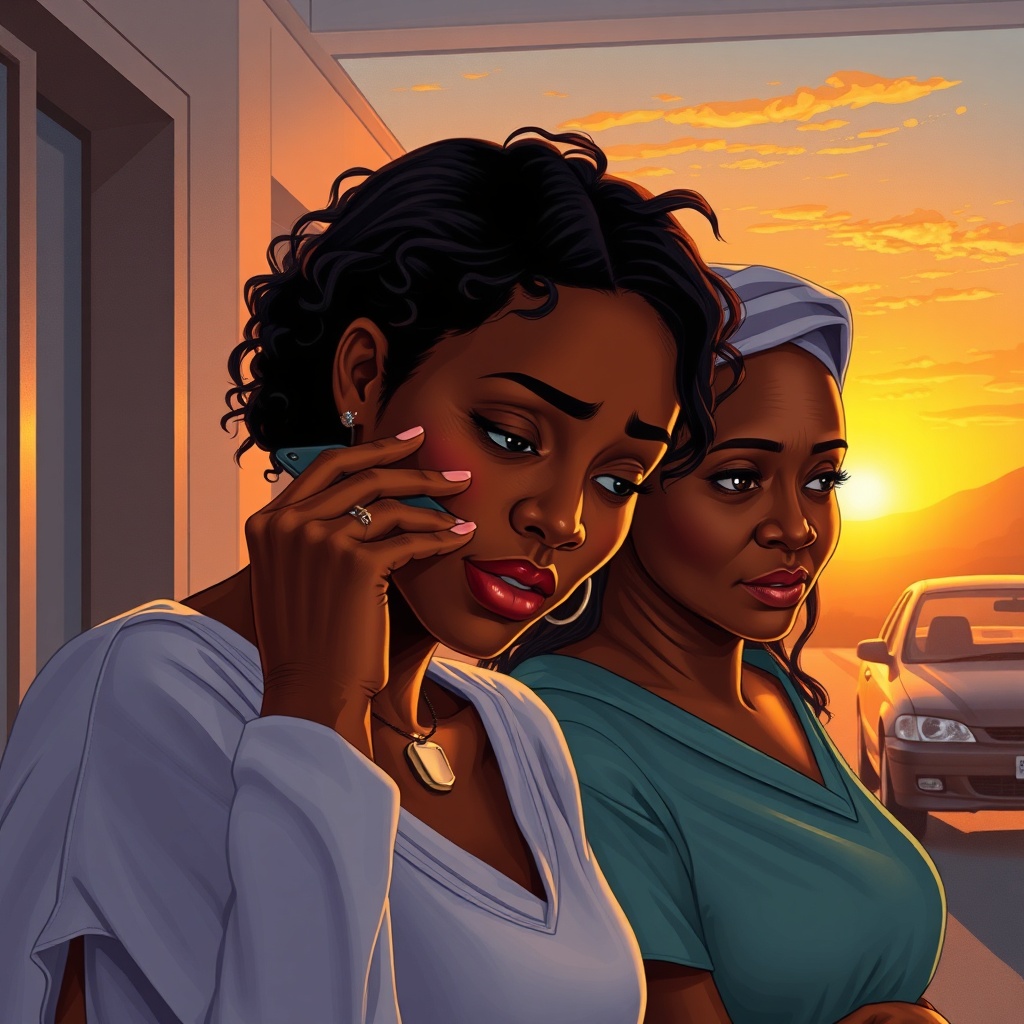
The day my mother died, a part of me died too. She wasn’t just my mother. She was my best friend, my safe place, my everything. She was the heart of our family, the kind of woman who lived for her children and especially for her grandchildren. They were her world. She loved them deeply and would do anything for them.
Then one day everything changed.
It started with severe cramps—something we thought might pass, something we believed doctors would help her recover from. Soon we learned that her intestines had been punctured and she needed surgery.
Then the hospital called.
They told us it was a matter of life and death and asked if we agreed to the surgery.
In that moment, we couldn’t even make a decision. We cried. The weight of choosing something so serious for the person who meant everything to us felt unbearable. I remember crying and telling the doctor that she was the only person we had. We didn’t have a father. She had been both a mother and a father to us. She carried the weight of both roles with strength, love, and sacrifice.
Even today, when I think about that moment, I still sob.
Everything happened so quickly.
While she was in pain, she still tried to be strong. I remember her telling me to take all her belongings home and reassuring me that she would be fine. Even in that moment, when she was hurting, she was still thinking about us.
Those were the last moments we spoke.
My last words to her were simple but full of love. I told her, “I love you, and I’ll see you tomorrow.”
I truly believed I would.
One of the last pieces of advice she gave me was something that still echoes in my heart today. She told me to be strong and never cry in front of my enemies. She said I must wait until the funeral preparations were over before letting my tears fall.
She wanted me to remain strong.
After the surgery, we saw her in the hospital on a ventilator. Seeing my mother lying there, connected to machines, unable to speak, almost lifeless, was one of the most painful moments of my life. The woman who had always been strong for everyone else was now fighting for her own life.
She stayed with us for only one more day.
When she died, something inside me went silent. I couldn’t cry. The pain was so deep that my body didn’t know how to react. I remember forcing my tears because the nurses wouldn’t let me stay with her any longer and they had to take me away from the room.
In that moment, my husband became my anchor. When I felt like I was falling apart, he held me up.
But grief did not only belong to me.
My grandparents were shattered by the loss of their daughter. My younger sister was traumatized. My children were confused, trying to understand how someone who loved them so much could suddenly be gone.
My uncle was in disbelief and deeply shattered as well. Losing her left a pain in our family that words can hardly explain.
My mother also had a very special relationship with my husband. She was more than just a mother-in-law to him—she was his advisor. They shared many meaningful and fruitful conversations. She loved him deeply and would often tell me that he was her first son. She protected him and cared for him as if he were her own.
Grief spreads through a family like waves. Everyone experiences it differently.
For a while, I tried to follow my mother’s advice. I tried to hold the pain inside and remain strong for everyone around me.
But grief does not always listen to strength.
Eventually, I could not hold it in any longer.
The tears came, the pain came, and the reality of losing her finally broke through the silence inside my heart.
And in that moment, I realized something important: being strong does not mean hiding your pain.
Grief is one of the most powerful emotions a human being can experience. Losing a parent can affect your mental health in ways people don’t always talk about. Some days you feel numb. Other days the sadness comes without warning. There can be anger, guilt, loneliness, and questions that may never have answers.
For a long time, I felt like I had died with her.
But grief also teaches you something powerful.
It teaches you that love does not disappear when someone dies.
Slowly, I began to understand that grieving is not about “moving on” from the person you lost. It is about learning how to carry their love in a different way. It is about allowing yourself to cry, to remember, and to heal in your own time.
Some days healing looks like talking about them.
Some days it looks like sitting quietly with your memories.
And some days it simply means surviving the day.
If you are grieving a parent, please know this: you are not weak for feeling broken. Your pain is proof of the love you shared.
Mental health during grief is something we must speak about more openly. It is okay to ask for help. It is okay to lean on the people who love you. Sometimes healing begins when we allow others to stand beside us in our pain.
The pain of losing my mother is still there. Grief never completely disappears. But when I think about the kind of mother she was, I realize something powerful.
I had a great mother.
The kind of mother many people only dream of having.
And if life gave me the choice again—today, tomorrow, or even in the next life—I would choose her as my mother all over again.
Every single time.